Every digital nomad is an online learner. And every digital nomad serves online learners, whether they call them clients, students, readers, or customers.
When I left the traditional academic path as a China-Africa scholar to build a remote career across writing, publishing, and online services, I became a full-time online learner again. I had to learn how to format books for self-publishing, how to secure Windows systems for remote work, how to price and deliver Dinka and Nuer interpretation online, and how to build a business that works across time zones.
That learning did not happen in a classroom. It happened through guides, templates, tutorials, community answers, and documented processes from other practitioners.
So who exactly are online learners for digital nomads? They are not a single persona. They are the people who learn from, with, and because of digital nomads: fellow nomads upskilling, remote workers adapting, independent professionals building service businesses, and clients learning how to work with remote experts.
This guide maps who these learners are, what they need, how they learn best while mobile or working remotely, and how creators and service providers can serve them in a human-first, practical way.
Key Takeaways
- Online learners for digital nomads include five overlapping groups: aspiring nomads, active nomads upskilling, remote employees, independent service providers, and clients learning to work remotely.
- They learn primarily to solve immediate problems, gain portable skills, and build income that supports location independence.
- They prefer practical, asynchronous, mobile-friendly, and low-bandwidth learning that links directly to services and templates.
- Credibility for these learners comes from real work examples, clear processes, ethical boundaries, and updated evergreen content.
- The most effective learning experiences connect content to action through checklists, templates, and service pathways in language, technology, and writing.
TL;DR
Online learners for digital nomads are people who use digital content to build portable skills, solve remote work problems, and create location-independent income. They include aspiring nomads, active nomads, remote employees, freelancers, and clients of remote services. They learn best from practitioner teachers who document real work, provide evergreen guides, templates, and service-linked pathways, and respect low-bandwidth, mobile-first, and asynchronous realities. Understanding who they are helps creators design content that is discoverable, applicable, and human-first.
What Online Learner Means in the Digital Nomad Economy
In a traditional sense, an online learner is someone enrolled in an online course. For digital nomads, the definition is broader and more practical.
An online learner for digital nomads is anyone who uses internet-based content, tools, and community to acquire skills, knowledge, or systems that support remote work, location independence, or collaboration with remote professionals.
That includes:
- A university student learning translation ethics from a practitioner guide.
- A humanitarian worker learning how to brief an interpreter for a field assignment.
- A new freelancer learning how to price editing services.
- A remote worker learning how to secure their Windows laptop for travel.
- An author learning how to prepare a manuscript for self-publishing while working from a co-working space in Nairobi or Hanoi.
Learning is not confined to a learning management system. It happens through blog posts, documentation, templates, newsletters, community answers, Loom videos, and service pages that teach while they sell.
In my own practice, I serve online learners daily through Language Services that include Dinka and Nuer interpretation and translation, Technology Services that include antivirus, Windows, and ICT support, and Writing Services that include writing, editing, and publishing support. Each service requires client education, and each educational asset creates more informed clients who get better results.
The 5 Core Types of Online Learners for Digital Nomads
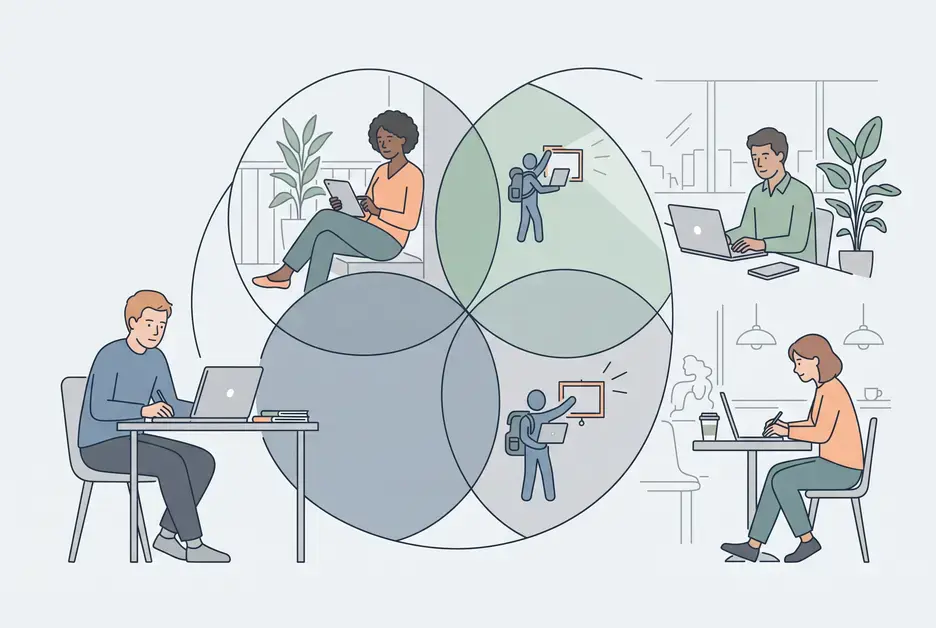
Online learners for digital nomads are not one audience. They are five distinct but overlapping groups with different motivations and constraints.
1. The Aspiring Nomad Learner
This learner has a location-dependent job or is studying, and wants to build skills for remote work and eventual location independence.
Goals: Portable skills, first remote clients, proof of work, understanding of remote work tools and security.
What they search for: How to start freelancing, how to get first clients for writing or translation, how to set up a secure remote workstation, how to self-publish a first book.
How they learn best: Step-by-step guides with checklists, starter templates, honest income and skill timelines, and examples of real service packages.
What they need from creators: Clarity on what to learn first, what to ignore, and how to link learning to a tangible service. Content that links to Writing Services or Technology Services with process explanations is highly valuable.
Challenge: Information overload and unrealistic promises. They need curators who filter and sequence learning.
2. The Active Nomad Upskiller
This learner is already location independent but needs to deepen skills to stay competitive, raise rates, or pivot.
Goals: Advanced specialization, higher-value services, systems that reduce time spent on repetitive tasks, better client acquisition.
What they search for: Advanced editing workflows, terminology management for translation, Windows hardening for handling sensitive client data, KDP optimization, Notion systems for client management.
How they learn best: Evergreen deep dives, comparison tables, behind-the-scenes process documentation, peer review, and small cohorts.
What they need from creators: Practitioner teachers who show how they actually work, not just theory. Documentation that respects low bandwidth and mobile access.
Example: A translator moving from general translation to humanitarian interpretation needs glossaries, ethics frameworks, and briefing templates from experienced practitioners in Language Services.
3. The Remote Employee Learner
This learner works remotely for a company and needs to collaborate effectively with distributed teams, including freelancers and contractors.
Goals: Asynchronous communication, remote security, cross-cultural collaboration, managing freelance contributors.
What they search for: How to brief a freelance editor, how to work with translators, how to secure remote devices, how to manage publishing workflows across time zones.
How they learn best: Concise guides, meeting agendas, briefing templates, security checklists, and case studies of remote team workflows.
What they need from creators: Content that teaches how to be a good client of remote services. For example, a guide on how to prepare a manuscript for editing saves both employee and freelancer hours.
Connection to services: Clear service pages in Technology Services that explain what information is needed for ICT support help remote employees become better requesters and collaborators.
4. The Independent Professional and Freelancer Learner
This learner runs a service business, often solo, and needs to learn business skills alongside craft skills.
Goals: Pricing, positioning, portfolio building, client acquisition, service productization, legal and financial basics for remote work.
What they search for: How to price translation per word versus per hour, how to create productized editing packages, how to write proposals, how to handle confidentiality and data security.
How they learn best: Templates, proposal samples, pricing calculators, real anonymized case studies, and small intentional communities.
What they need from creators: Business-focused educational content that is linked to real services. A guide on manuscript assessment that ends with a productized review package is more useful than generic business advice.
Why this matters: Many freelancers learn craft in school but never learn service design. Creators who offer Writing Services and document how they package and price those services fill a critical gap.
5. The Client Learner
This is the most overlooked type of online learner for digital nomads. These are the clients who hire digital nomads and need to learn how to work with them effectively.
Goals: Understanding what to expect from translation, interpretation, editing, or ICT support, how to prepare files, how to evaluate quality, and how to protect sensitive data.
What they search for: What is included in academic editing, how to prepare for interpretation, how to secure files before sending for translation, what turnaround to expect.
How they learn best: Service pages that teach, FAQs that answer real questions, short Loom videos explaining process, and glossaries that define terms.
What they need from creators: Human-first service education. For example, a client seeking Dinka interpretation benefits from a guide that explains consecutive versus simultaneous, confidentiality protocols, and how to brief an interpreter, all available through Language Services.
When client learners are educated, projects go smoother, revisions drop, and trust increases. Teaching clients is not extra work. It is part of delivering excellent remote service.
What Online Learners for Digital Nomads Have in Common
Despite different goals, these learners share seven characteristics that should shape how we create content for them.
1. They learn to solve immediate problems. Unlike traditional students who may study for future credentials, online learners for nomads search when they have a deadline, a client request, or a tool that broke. Content must answer the immediate question quickly, then provide depth for later.
2. They are time and bandwidth constrained. Many access content on mobile devices, with limited data, or between client tasks. Short paragraphs, clear H2s, bullet lists, tables, and downloadable checklists respect that constraint.
3. They are globally distributed. Non-native English speakers, different educational backgrounds, and varied cultural contexts mean plain language, defined terms, and examples that travel well are essential.
4. They value proof over promises. They trust documented process, before and after samples with permission, and case studies over hype. They want to see how you handled a real manuscript, a real malware removal, or a real interpretation assignment.
5. They need pathways to application. Learning without a next step feels incomplete. Every guide should end with a template, checklist, or service pathway that helps them apply what they learned through Writing Services, Technology Services, or Language Services.
6. They learn in fragments, not semesters. Micro-learning, evergreen hubs, and searchable FAQs fit their reality better than long linear courses that require cohort timing.
7. They care about ethics and confidentiality. Especially in language and humanitarian work, learners want to know how to handle sensitive information responsibly. Creators who model confidentiality build deeper trust.
How Online Learners Find and Vet Content from Digital Nomads
Understanding discovery helps both learners and creators.
Stage 1: Problem-triggered search. Learner types a specific, task-based query: how to format a book for KDP, how to clean Windows 11 after virus, how to brief interpreter for medical assignment.
Stage 2: Quick relevance check. Learner scans first paragraph for direct answer, checks H2s for structure, looks for date, author experience, and whether content links to real services.
Stage 3: Sample application. Learner tries a checklist or template from the guide. If it works, they bookmark the creator and subscribe to newsletter.
Stage 4: Deeper learning and hiring. Learner returns for related guides, joins a small community, or hires for a productized service.
This is where SEO, AEO, and GEO meet human-first writing. Search and answer engines surface content that directly answers questions, uses clear headings, includes tables and FAQs, and demonstrates expertise. Human readers stay when that content is practical, ethical, and respectful of their context.
For creators, this means:
- Write meta titles under 60 characters that state the problem clearly.
- Write meta descriptions around 100 characters that promise a practical outcome.
- Use H2s that mirror learner questions.
- Add key takeaways, TL;DR, and FAQs to help both humans and answer engines extract value.
- Link naturally to service categories where application happens.
What Online Learners Need Most From Digital Nomad Creators
Based on years of serving learners and being a learner, these are the highest-value content types.
1. Process documentation. Not just what to do, but how you do it step by step with decision points. Example: my editing workflow from manuscript intake to final delivery.
2. Checklists and templates. A manuscript readiness checklist, a remote work security checklist, an interpreter briefing template. These reduce cognitive load and improve quality.
3. Comparison and decision guides. Honest comparisons of tools, workflows, or service models with pros and cons from real use, not affiliate lists.
4. Case studies with permission. Anonymized stories of how a translation project was managed under tight deadline, or how a self-publishing client moved from draft to distribution.
5. Glossaries and frameworks. For language learners, terminology matters. For technology learners, clear definitions of malware types, backup strategies, or Windows settings matter. For writing learners, definitions of developmental editing versus copyediting matter.
6. Service education pages. Pages that teach while they sell. Instead of just listing prices for Language Services, explain confidentiality, preparation, file formats, turnaround factors, and revision policy.
Comparison table of learner needs versus creator asset:
| Learner Need | Best Creator Asset | Example Linking to Services |
|---|---|---|
| I need to do this task today | Checklist plus short tutorial | Manuscript final proof checklist linked to Writing Services |
| I need to understand options | Comparison table with real testing | Antivirus comparison with hands-on notes linked to Technology Services |
| I need to hire well | Service education page plus FAQ | How to brief an interpreter guide linked to Language Services |
| I need a reusable system | Template plus documentation video | Client onboarding Notion template for freelance editors |
| I need to avoid mistakes | Common mistakes guide with fixes | Top 10 self-publishing formatting errors and how to fix them |
Challenges Online Learners Face in the Nomad Context
1. Low bandwidth and unstable connectivity. Heavy video, unoptimized images, and auto-playing content frustrate learners. Offer lightweight text versions, compressed images, and downloadable PDFs that work offline.
2. Tool and version fragmentation. A Windows tutorial from 2019 may not match Windows 11. Date your content, note versions, and provide update logs.
3. Confidentiality and data sensitivity. Learners handling sensitive documents need guidance on secure file transfer, encryption, and ethical handling. This is core to both Language Services and Technology Services.
4. Motivation without cohort. Self-paced learning requires self-discipline. Small accountability groups, weekly co-working sessions, and newsletter prompts help learners apply what they learn.
5. Credibility noise. AI-generated content has increased volume but not always accuracy. Learners need filters: author experience, real work examples, source attribution, and correction policies.
How Digital Nomads Can Design Human-First Learning Experiences
1. Start with learner questions, not your expertise. Mine support emails, community questions, and client briefs for 20 real questions. Use those as your content calendar.
2. Create evergreen hubs, not scattered posts. Build resource hubs for each service area: a self-publishing hub, a remote Windows security hub, a humanitarian interpretation preparation hub. Each hub contains guides, checklists, templates, and FAQs interlinked.
3. Respect mobile-first and offline-first realities. Use short paragraphs, descriptive link text, alt text for images, and provide text transcripts for videos. Offer PDFs that work offline.
4. Link learning to service clearly. After teaching how to assess manuscript readiness, link to your productized manuscript assessment service. After teaching how to prepare for interpretation, link to your briefing template and your Language Services inquiry page.
5. Build feedback loops. End every guide with a question: what did you try, what confused you, what template would help next? Use answers to improve the guide.
6. Model ethical practice. Disclose AI use, protect confidentiality, credit sources, and avoid invented statistics. For online learners in sensitive fields, ethical modeling is part of the curriculum.
7. Design for async and live. Provide async assets for self-paced learning and optional live office hours or small cohorts for those who need interaction. This serves both introverted and extroverted learners.
Business Models That Serve Online Learners Sustainably
For digital nomads who teach, these models balance impact, income, and energy.
1. Service-Led Education: Free evergreen content drives inquiries for high-value services like editing, translation, or ICT audits. This is the most direct and sustainable for solo professionals.
2. Productized Education plus Service: Sell a template or checklist for a low price, then offer an implementation service. Example: self-publishing checklist plus formatting service.
3. Small Cohorts for Application: Run 4-week cohorts of 8 to 12 learners who apply evergreen content with feedback. This leverages community without requiring daily live presence.
4. Licensing to Organizations: License your interpretation preparation materials or remote security guides to NGOs, schools, or companies that train distributed teams.
5. Newsletter as Learning Journey: A weekly newsletter that sequences evergreen content into a learning path, with one actionable template per issue, builds trust and keeps learners engaged between large guides.
Each model works best when anchored to clear service pages in Writing Services, Technology Services, and Language Services that show process, outcomes, and ethical standards.
Reflection Questions
- Which of the five learner types, aspiring nomad, active upskiller, remote employee, independent professional, or client learner, do you serve most often, and how does that shape your content?
- What is the most common immediate problem your audience searches for, and does your top guide answer it in the first two paragraphs?
- How do you currently handle low-bandwidth, mobile-first, and confidentiality needs in your learning content?
- What is one checklist or template from your real client work that would help an online learner apply what you teach this week?
- How can you connect your evergreen educational content more clearly to a productized service that helps learners get results?
FAQs
1. Who exactly are online learners for digital nomads?
Online learners for digital nomads are anyone who uses digital content to build portable skills or work effectively with remote professionals. They include aspiring nomads, active nomads upskilling, remote employees, independent freelancers, and clients who hire remote services and need to learn how to collaborate well.
2. How are online learners for digital nomads different from traditional online students?
They learn to solve immediate, practical problems tied to income and location independence, not just for credentials. They prefer asynchronous, mobile-friendly, checklist-driven content that links directly to templates and services rather than semester-long linear courses.
3. What do online learners for digital nomads need most from content creators?
Process documentation, checklists, templates, comparison guides with real testing, and service education pages that explain how to prepare, what to expect, and how to evaluate quality. Content that links naturally to services like Language Services and Writing Services helps them move from learning to application.
4. How can digital nomads create content that serves low-bandwidth learners?
Use short paragraphs, clear H2s, compressed images with alt text, text transcripts for videos, and downloadable PDFs that work offline. Avoid auto-play video and heavy scripts. Date your content and note tool versions so learners know if instructions still apply.
5. Can online learners become content creators for other online learners?
Yes. The most effective path is to document your own learning and application process as you implement what you learn. Share checklists you improved, mistakes you fixed, and templates you customized. This document-as-you-learn approach helps learners just behind you and builds your own portfolio of practical assets.
Conclusion
Online learners for digital nomads are not a distant audience. They are your peers, your clients, your collaborators, and your future self.
They are the aspiring translator trying to understand confidentiality, the author formatting a manuscript between co-working sessions, the remote employee briefing a freelance editor, and the NGO worker preparing for a field assignment with an interpreter. They learn in fragments, on mobile devices, between tasks, and they need content that respects that reality.
As a creator and service provider, your opportunity is to teach from real work, organize knowledge into evergreen, searchable assets, and link learning to clear next steps through Language Services, Technology Services, and Writing Services.
When you serve online learners this way, you do more than grow an audience. You build a portable, human-first business where content, community, and service reinforce each other, no matter where you are working from.
Learning online works best when it is practical, ethical, and immediately applicable. That is what online learners for digital nomads are looking for, and that is what thoughtful creators can deliver.
And if you want to know what’s happening in my world as a writer and digital nomad, check out my Wealthy Affiliate blog page here: https://my.wealthyaffiliate.com/johnmaluth/blog.